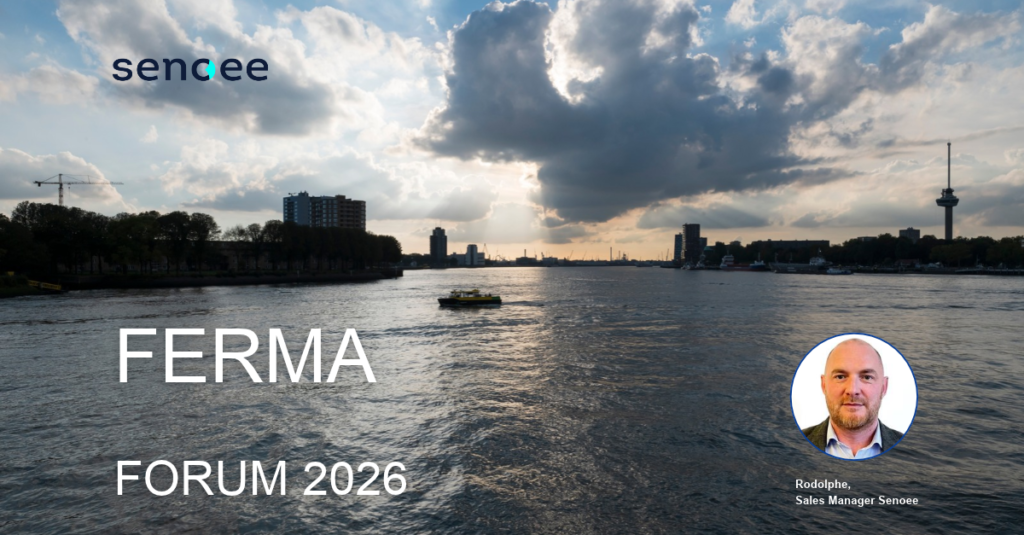
From 4 to 6 October 2026, SENOEE attended the FERMA Forum in Rotterdam. Following 3 days of discussions with risk management and insurance professionals, Rodolphe, our Head of Sales, shares his insights into the industry's evolving expectations around data quality, asset valuation and keeping insured values up to date.
From understanding the risks being transferred to insurers and managing multi-site asset portfolios to making data available for use across different business functions, this interview explores the practical challenges facing industry professionals.
SENOEE attended the FERMA Forum. How prominent are asset valuation, data quality and asset visibility in today’s risk management discussions?
Rodolphe : At FERMA, the importance of data was highlighted across all lines of insurance: data that is accurate, high-quality, traceable, verifiable and auditable. This is particularly important in… in property insurance, which is our area of expertise.
For a company, having a clear understanding of its assets helps it better characterize the risk it intends to transfer to insurers.
For insurers, these informations help assess risk exposure and determine insurance terms, particularly premiums and coverage limits. It also supports the assessment of accumulated exposures, for example when several sites are located in the same geographical area exposed to a common risk.
This was a recurring theme in the discussions and workshops we attended: beyond asset valuation, the central issue is having a detailed understanding of the assets to be insured.
How would you assess companies’ current level of maturity in understanding and managing their insured values?
Rodolphe : The level of maturity still varies considerably, as companies differ in their activities and risk exposures. Some, particularly in the industrial sector, have had to develop a much more detailed understanding of their asset portfolios following losses in recent years. Other Risk Managers are still working with the information available internally, which can sometimes be incomplete or fragmented.
There is growing awareness of the importance of providing insurers with reliable insured values, as the quality of this data influences risk assessment and the insurance terms offered. However, not all companies have information that is readily usable for insurance purposes.
The challenge is therefore not just to establish an initial asset register with associated values, but also to maintain and manage it over time. Reliable data at a given point in time is not enough if it cannot be kept update.
Are you seeing a shift in the Risk Manager’s role in how data is collected, validated and used?
Rodolphe : Risk Managers may come from engineering, legal or financial backgrounds. Regardless of their background, their role is inherently cross-functional: they work closely with finance and accounting teams, real estate departments and, in industrial companies, technical teams. They play a central coordinating role.
Until now, the Risk Manager has often been seen as the person responsible for gathering information from these different departments. With SENOEE’s insurance appraisal and asset valuation programmesthe aim is also to enable Risk Managers to share structured, reusable information with these teams.
Finance direction can access data on the replacement cost new of assets; technical and maintenance teams can use a structured inventory of equipment and its locations; while real estate teams can benefit from updated information on building floor areas and characteristics recorded during site visits.
Our aim is therefore not only to provide reliable asset valuations for insurance purposes, but also to deliver structured asset data that can be used by other departments across the company.
Are you seeing a shift from using data primarily for insurance coverage at specific points in time towards an ongoing need for data to manage asset portfolios?
Rodolphe : Yes, because the scale and frequency of the need have changed. In some organisations, insurance appraisals could previously be focused on the largest sites, with several years between site visits. Today, however, the insurance market expects up-to-date and sufficiently comprehensive data across the entire insured asset portfolio.
However, carrying out a new insurance appraisal every six months to track every investment or change at a site is simply not feasible. Our approach is to use the initial insurance appraisal as a baseline, then update asset valuations based on the technical characteristics of each site, using our algorithms. This goes beyond simply applying an inflation adjustment factor or an industrial risk index.
This also allows us to account for capital investments and asset disposals more precisely. Our valuation classes 3 and 4, for example, enable us to incorporate the technical characteristics of equipment or buildings added to or removed from the asset portfolio. It is important to distinguish overall project costs from those that should actually be included in insured values, to avoid both overstatement and understatement of declared values.
The objective remains the same : to maintain accurate, verifiable and up-to-date insured values, year after year.
What are the main blind spots companies tend to underestimate when they believe they have an accurate, up-to-date view of their asset portfolio?
Rodolphe : The first blind spot is often how outdated the source data is. Before launching an initial programme, we frequently encounter companies that have financial, real estate or technical data available, but have been relying on it for years without really having the means to reassess its accuracy.
During initial insurance appraisals, we sometimes identify significant discrepancies. These relate not only to asset values, but also to floor areas and the activities carried out at individual sites. Some asset registers are based on information accumulated over ten, fifteen or twenty years, sometimes even longer, despite significant changes to the assets themselves.
For example, a site originally used for office activities may have since added a warehouse for storage, without this change being properly reflected in financial or real estate records. The insurance appraisal then provides an opportunity to reassess and update the underlying reference data.
This is not due to a lack of commitment on the part of Risk Managers. The challenge is often that they lack both easy access to all the relevant information and the resources needed to consolidate it.
Looking at the discussions over these three days from a broader perspective, what structural changes do you see emerging in how companies will need to manage their risks and assets?
Rodolphe : Technology now makes it easier to update data and track changes over time. It can also improve the transparency of information shared with insurance partners.
However, establishing a reliable starting point remains challenging: identifying where the data comes from, verifying that it reflects actual site conditions and determining which information has not been updated. Some companies still rely on outdated databases without always being able to establish how old the information is or verify it against conditions on the ground.
What we heard at FERMA, from Risk Managers, underwriters and risk prevention specialists alike, was a clear expectation for reliable, objective and auditable data. Our approach to asset valuation combines collected data with detailed asset characteristics to establish a common reference framework that can be understood by the different stakeholders involved.This common framework facilitates discussions about the risks being transferred to insurers.
Following this year’s FERMA Forum, has any of your existing beliefs been reinforced, or have you gained a new perspective on how the industry is likely to evolve?
Rodolphe : FERMA reinforced my conviction that data plays a central role in risk management. It remains essential for assessing risk exposure, insurability and risk transfer, but its value extends well beyond the annual placement of an insurance programme.
The technical characteristics of buildings and equipment, their locations and the information gathered during insurance appraisals can also inform longer-term planning. This is particularly relevant when it comes to adapting to climate change.
Take a production site whose operations depend on water availability. By combining knowledge of the site's processes and equipment with climate scenarios, we can better assess its future exposure. Another example concerns equipment such as air conditioning and refrigeration systems, which have operating temperature limits. Some models shut down when temperatures reach 42°C. Having access to their technical specifications helps identify potential vulnerabilities and inform decision-making.
For me, this represents an important shift: data collected to value assets and document insurable risks can also support discussions on how to adapt an organisation’s asset portfolio over the short, medium and long term.
CONTINUE THE CONVERSATION
Would you like to assess the reliability of your asset portfolio’s insured values and how they are kept up to date? Speak with Rodolphe, Head of Sales at SENOEE, to discuss your existing sites and asset data.